
Tanzania Travel Tips for First-Time Visitors: A Practical Planning Guide
Posted on 6/5/2026 by Tanzania eVisa Immigration Assistance Service
Updated on 8/10/2026
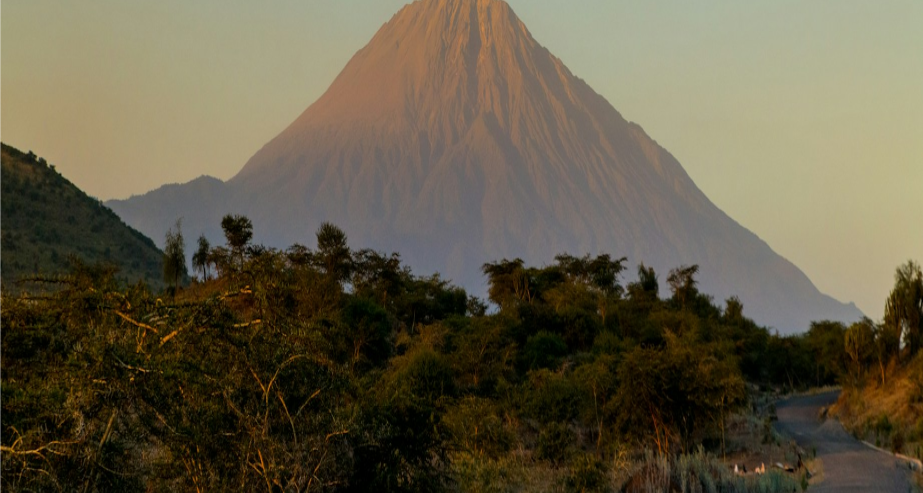
For a first Tanzania trip, settle the essentials in this order: confirm your entry route and nationality requirements, choose a realistic itinerary, book a reputable operator where needed, arrange appropriate insurance, and check current health guidance. Tanzania is a large country, so leaving enough travel time between safari parks, cities and Zanzibar matters more than trying to include every highlight.
First-trip checklist
| Before departure | What to confirm |
|---|---|
| Entry permission | Use the Tanzania visa requirement checker for your nationality; some travelers are visa-exempt and some applications require referral approval |
| Passport and itinerary | Check passport validity, blank-page and onward-travel requirements against the current Tanzania Immigration entry requirements |
| Arrival point | Confirm that your airport, seaport or land border is suitable for your route; see the Tanzania eVisa entry-points guide |
| Health preparation | Review current destination advice and discuss individual risks with a qualified travel-health professional |
| Insurance | Check medical treatment, evacuation, trip disruption and any planned high-altitude or adventure activities |
| Transport | Allow buffer time between road transfers, domestic flights and international departures |
Do not submit duplicate visa applications because a decision is taking longer than expected. Our standard guidance is to allow up to 15 business days, while referral cases can take longer because immigration approval is required.
Build a realistic itinerary
Tanzania's main travel regions are separated by long distances. A northern safari circuit, the southern parks, Zanzibar and Kilimanjaro are not one compact destination.
- For a short trip, prioritize one region instead of losing days to transfers.
- Use domestic flights selectively when they save a full day of road travel.
- Keep a buffer before your international flight, particularly after a bush flight or ferry connection.
- Match the route to the season and activity rather than assuming there is one universal “best month.” Our weather and season guide explains the main trade-offs.
- Compare routes in the best places to visit in Tanzania guide.
What to pack
Safari and general travel
- Lightweight layers for warm afternoons and cooler early-morning drives
- A light rain layer appropriate to the season
- Comfortable closed shoes and sandals for lodges or the coast
- Hat, sunglasses and sun protection
- Binoculars, spare camera batteries and memory cards
- Refillable bottle, small daypack and power bank
- Personal medication in original packaging, plus copies of prescriptions where relevant
- A Type G power adapter; confirm voltage compatibility for specialist equipment
Neutral clothing is practical on dusty game drives, but there is no need to purchase an entirely new safari wardrobe. Avoid military-style camouflage, and check current customs rules before packing restricted goods. Tanzania restricts plastic carrier bags, so use reusable alternatives.
Zanzibar and towns
Swimwear belongs at the beach or pool. Carry a cover-up and dress more conservatively in towns, villages and religious locations, particularly in Zanzibar. Shoulders and knees covered is a useful default when you are unsure.
Health preparation without guesswork
Health advice depends on the traveler's medical history, exact route, season, activities and countries visited before Tanzania. A general article cannot determine which vaccines or medicines are suitable for you.
- Check the current CDC Tanzania traveler guidance or the equivalent public-health authority in your country.
- Discuss malaria risk and prevention with a qualified clinician; recommendations can vary by area and individual circumstances.
- Yellow-fever certificate rules depend partly on where you arrive from and sometimes on transit history. Verify the current entry rule for your exact routing rather than relying on an old checklist.
- Bring adequate supplies of prescribed medicine and check whether any item is controlled at your destination.
- Use safe drinking water, wash hands, protect against sun exposure and take sensible food-hygiene precautions.
For remote safaris or mountain travel, insurance should explicitly cover the locations, altitude and activities in your itinerary. “Adventure cover” is not identical across policies.
Money, cards and cash
The Tanzanian shilling (TZS) is the local currency. Cards are common at many established tourism businesses, but cash remains useful for smaller purchases and places with weak connectivity. Acceptance, surcharges and ATM limits vary.
- Carry more than one payment method and keep backup funds separately.
- Use banks, ATMs in secure locations or authorized exchange providers.
- Check the exchange rate and all fees before accepting a transaction.
- Ask your safari or trekking operator for its current tipping policy; appropriate amounts vary by service, group size and what is already included.
- Confirm which trip costs are included before comparing quotes—park fees, transfers, meals and activities can change the total substantially.
See the Tanzania currency, ATM and card guide for a fuller decision checklist. Avoid building a trip budget from a fixed daily figure in an undated article: season, route, park fees, accommodation standard and whether transport is private have a much larger effect.
Getting around Tanzania
Domestic flights
Small aircraft connect several safari airstrips and islands. Check baggage weight and dimensions with the operating airline, not only with the company that sold the overall itinerary. Schedules may change, so avoid a tight same-day international connection.
Road transfers
Travel times depend on road condition, weather, stops and park gates. Ask for realistic door-to-door timing. Self-driving may suit experienced travelers on some routes, but remote roads and park driving require additional planning; many first-time safari visitors use a licensed operator and driver-guide.
Ferries and local transport
Use authorized ticket channels, keep valuables with you and confirm the correct terminal. In cities, ask your accommodation or operator which transport services are currently reliable rather than accepting an unsolicited ride.
Safari etiquette and wildlife safety
- Follow your guide and park rules at all times.
- Stay in the vehicle unless a guide says you are in a designated place where leaving it is permitted.
- Never feed, call to or crowd wildlife for a photograph.
- Keep noise low and let animals choose their own direction.
- Do not pressure a driver to leave permitted tracks or block another vehicle.
- Wildlife sightings and migration river crossings are never guaranteed.
- Ask before using a drone; national, park and local restrictions can apply.
The best safari is not simply the longest species checklist. Quiet observation, enough time in each area and a responsible guide usually produce a better experience.
Respectful travel and photography
Swahili greetings such as habari and asante are appreciated, but courtesy matters more than perfect vocabulary. Ask before photographing a person, and respect a refusal without negotiating. Permission to photograph a public location does not automatically cover ceremonies, government facilities or security-sensitive areas.
In markets, clarify the price before purchasing and bargain politely where it is customary. Support locally owned guides, restaurants and craft businesses when possible, and avoid buying wildlife products or items whose origin is unclear.
Food, water and connectivity
Eat at clean, busy establishments, choose food that is thoroughly cooked, and use drinking water from a source you trust. Travelers with allergies should communicate ingredients clearly and tell the operator before entering remote areas.
Mobile coverage is strongest in populated areas and can be limited in parks. An unlocked phone may accept a locally registered SIM, but registration requirements and available plans change. Download maps, bookings, insurance details and essential contacts for offline access.
Common first-time mistakes
- Planning too many regions in too few days.
- Assuming every nationality follows the same visa process.
- Treating a migration calendar as a guarantee of animal location.
- Booking insurance without checking evacuation or activity exclusions.
- Relying on one card or expecting connectivity everywhere.
- Packing around generic internet advice instead of the actual route and season.
- Making tight connections after bush flights, ferries or long road transfers.
- Photographing people without permission or ignoring local dress expectations.
Frequently asked questions
Does every visitor need a Tanzania eVisa?
No. The result depends on nationality and circumstances. Some nationalities are visa-exempt, some can use the standard online process, and referral-visa nationalities need prior immigration approval. Start with the nationality checker and verify unusual cases with Tanzania Immigration.
Is Tanzania safe for tourists?
Risk varies by location, activity and current conditions. Review your government's latest travel advisory, use reputable operators, protect valuables, avoid isolated areas after dark and follow local instructions. An organized safari does not remove the need for normal travel precautions.
Can I rely only on cards?
It is safer to carry a mix of payment methods. Card terminals and ATMs can be unavailable or offline, especially outside major towns. Confirm payment methods with each accommodation or operator before travel.
Do I need to speak Swahili?
English is used widely in the tourism sector. Basic Swahili greetings are helpful and respectful, but visitors can usually arrange a trip without speaking Swahili.
How far ahead should I plan?
Book earlier for limited-capacity lodges, popular seasons and complex routes, but do not apply arbitrary “three to six month” rules to every part of the trip. For an eVisa, allow up to 15 business days under this service's processing guidance and more time for referral cases. The processing-time guide and how to apply walk through the same rules in more detail.
Final pre-departure check
Reconfirm your flight and transfer times, entry permission, passport details, insurance, health advice and operator contacts shortly before departure. Keep electronic and offline copies of essential documents. A focused route with sensible buffers will usually make a first Tanzania visit smoother than an overloaded itinerary.
Content reviewed: 10 August 2026. Entry, health, transport and park rules can change; verify time-sensitive requirements for your specific trip.